How to save a voicemail from someone who has died
Save it as a file first, then deal with the phone line. Voicemails can vanish when a line is canceled or transferred (T-Mobile says both permanently delete voicemails and greetings), when a SIM card is changed, or when a mailbox's time limit runs out. On an iPhone, use the voicemail's Share button › Save to Files; on Android, Save, Archive or Send to. Then keep two copies, a WAV and an MP3, in two places.
On this page (5)
A voicemail is often the only recording of how someone said your name. When they’ve died, it’s also one of the few things with a deadline attached, while everything else can wait. This page is the order to do things in, with what the phone makers and carriers say on their own help pages. Take it one step at a time.
What should you do first?
Before anyone cancels, transfers or resets anything, save the messages as files. The three things that delete voicemails without asking are all things people do in the weeks after a death:
- Canceling or transferring the line. T-Mobile’s page for a deceased family member’s account says: “Ensure all voicemails are backed up before initiating a transfer of ownership or account cancellation. Transfers or cancellations will result in the permanent deletion of voicemails and greetings.” Its cancellation page adds that voicemail messages “are permanently deleted after cancellation and cannot be recovered.”
- Changing the SIM card or resetting the phone. Apple’s voicemail page warns: “Your voice messages may also be deleted if you change your SIM card.”
- Mailbox time limits. AT&T keeps basic voicemail “for a period of 14 days” and visual voicemail “for a period of 30 days” (AT&T, updated March 19, 2025). T-Mobile’s auto-save period “can be from 14 to 30-days” (T-Mobile).
Verizon’s deceased account page is the gentlest about it: “Before disconnecting a line, you can save any voicemails from that line. Contact us to learn more.” It also lists keeping the line as it is as an option (“No action is needed. You continue to be billed for the line”). AT&T’s bereavement page (updated September 1, 2026) doesn’t mention voicemail; it can keep the lines active on another AT&T account, and says AT&T doesn’t charge early termination or other cancellation fees for the deceased person’s line. If you’re not sure what a change will do, it can be worth keeping the line a few more weeks while you save what matters.
Whose phone is the voicemail on?
There are two different situations, and people often have both:
- Messages they left you are on your phone or in your mailbox. Their line closing doesn’t touch them, but your own phone’s limits do. Save them the normal way: on an iPhone (Share › Save to Files) or on Android (Save, Archive or Send to).
- Messages on their phone, and their greeting (“Hi, you’ve reached…”) live on their line. Those are the ones the cancellation deletes. Saving them needs their phone unlocked or their voicemail PIN, and the line still active. The greeting can be recorded by calling the number: see saving a voicemail greeting. If they used Google Fi or Google Voice, their voicemails can also be exported from the Google Account.
Keep the voicemail: the recording, the words and a print
Choose the voicemail you want to keep
M4A, AMR, 3GP, MP3 or WAV, from any phone. Or drop it here.
No file yet? or read how to get the file off your phone.
1 Listen and trim
2 Save the recording
Keep both: the WAV is the sound exactly as it came off the phone, and the MP3 is smaller and plays on every phone, computer and car.
Saving the files is part of Pro. Your voicemail stays open here as you left it, and unlocks as soon as you've paid.
Pro is coming soon · $12 to keep it forever
- Save the recording as MP3 and WAV (and M4A where the browser can make it), trimmed as you like
- Save the words as a text file, also stored inside the MP3
- Save the keepsake print as a 300 dpi PDF and picture, in five sizes
- Everything in one ZIP, with a note saying what each file is
Everything here is free while we launch. Leave your email and we'll write once, when Pro is ready.
3 The words (optional)
A small speech model writes out what was said, on this device, in English. It downloads about 30 MB the first time (Wi-Fi is best) and is quickest on a computer or a recent phone. It gets some words wrong: read along while you listen. Or type the words yourself.
4 The keepsake print
That's more words than fit on this size, so the print ends with “…”. Shorten them, or pick a bigger size.
Add a QR code that plays the recording
We don't keep your recording anywhere, so the code needs a link to a copy you put online: save the MP3, upload it to your Google Drive, iCloud Drive or Dropbox, share it as "anyone with the link", and paste that link here. Then scan the preview with your phone before you print. How to make the link.
That doesn't look like a web link. It should start with https://
300 dpi, the exact size you picked: print it at home on card stock, or take the picture to a photo counter.
The MP3, the WAV, the words and the print together, with a note saying what each file is. Keep a copy in two places.
Runs in your browser. The recording never leaves your device. No sign-up.
How do you save it once you have the file?
Open it in the tool above. Nothing is uploaded; it all happens on the device in your hand.
- Listen and, if you want, trim the silence or the carrier’s announcement at the ends. The original on the phone isn’t changed.
- Save the WAV and the MP3. The WAV is the sound exactly as it came off the phone; the MP3 is smaller and plays everywhere.
- Write out the words if you’d like them, and correct anything the speech model got wrong.
- Make a print with their name, the date and a line of their words, if that would help. It can go in a frame, in a card or in the order of service.
- Save everything in one ZIP, with a note saying what each file is, and copy it to a second place.
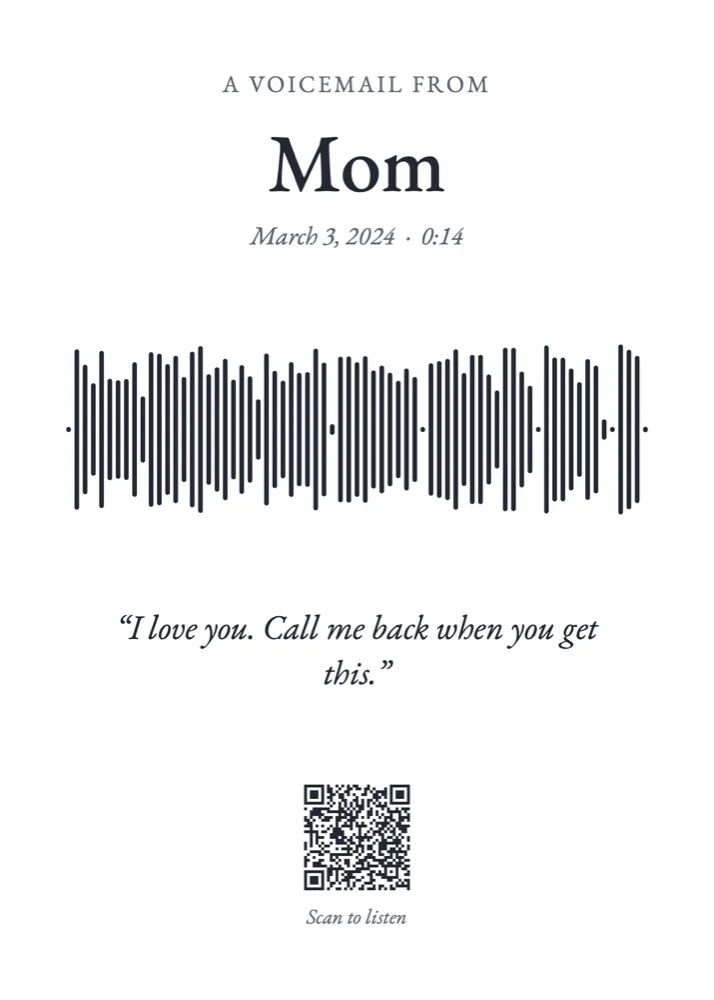
A print made from a made-up test message. Yours shows their name, the date the message was left and the words you choose.
What if it’s only in the dial-in mailbox?
If you can only hear it by calling the mailbox, there’s no Save button, but there are still ways:
- Keep it from expiring. T-Mobile says to “select the 9 key to save the message. You can repeat this to save the message in your voicemail box before the auto-save period runs out.” AT&T’s page gives the same key: “Press 9 to save a message.”
- Ask for a copy (Verizon). Verizon’s voicemail FAQ says “permanent copies of your voicemail messages can be made through CBW Productions, Inc. for a minimal fee,” adding “This isn’t a Verizon wireless service” and that the message “MUST still be present in your voice mailbox.” Details on our Verizon page.
- Record it. Play it on speaker and record it with a second phone. It loses a little of the quality, never the voice. Here’s how to get a clean recording.
How do you keep it safe for years?
- Two formats: WAV (lossless) and MP3 (plays everywhere). The tool saves both, and stores the name, the date and the words inside the files.
- Two places at least: a computer and a cloud drive, or a cloud drive and a USB stick in a drawer.
- Other people: send the ZIP to a brother, sister or child. Families lose files one person at a time.
- Not only on the phone, and not only in the phone’s backup: Apple’s list of what iCloud backs up mentions the Visual Voicemail password, not the messages.
There’s no wrong time to do the rest. The words, the print and sharing it with family can wait until you’re ready; saving the file is the part that can’t.
Questions people ask
Will canceling a dead person's phone line delete their voicemails?
It can. T-Mobile says cancellations and transfers of ownership 'will result in the permanent deletion of voicemails and greetings.' Verizon says you can save voicemails before disconnecting a line and to contact it to learn more. AT&T's page doesn't say. Save every message you care about before changing anything.
I have voicemails they left on my phone. Are those at risk too?
Less, but yes. Messages someone left you sit in your own mailbox or Phone app, so their line closing doesn't touch them, but your carrier's time limits and your next phone or SIM card can. AT&T, for example, keeps visual voicemail for a period of 30 days. Save them as files now.
Can I get a voicemail off a phone I can't unlock?
We can't help get around a passcode, and neither can this tool. If the voicemail is in the carrier's mailbox, the carrier may be able to help the account holder or executor; Verizon's deceased-account page says to contact it before disconnecting the line. Keep the line active while you ask.
Which file format will last longest?
Keep two: a WAV, which is the sound exactly as it came off the phone and loses nothing when copied, and an MP3, which nearly everything plays. Store them in two places that don't depend on one phone, and give a copy to someone else in the family.
Is VoicemailKeepsake free?
Yes, while we launch: saving the recording, the words and the print cost nothing and need no sign-up. Later, saving the files will be part of Pro, $12 once, for every voicemail you keep on that device.
Related
- Save a voicemail on iPhoneSave a voicemail from the iPhone Phone app as an audio file with the Share button, in the Unified and Classic layouts, then keep it as MP3 and WAV.
- Save a voicemail on AndroidSave a voicemail from an Android phone as an audio file: Google's Phone app, Samsung and carrier voicemail apps, and what to do with no button.
- Record a voicemail you can't exportNo way to save a voicemail on your phone or carrier? Record it with iPhone call recording or on speaker into a second phone, then trim and keep it.
- Sound wave printTurn a voicemail into a sound wave print with the name, the date, the words and a QR code. 300 dpi PDF or picture in 5 sizes, made on your device.
- All guidesEvery VoicemailKeepsake guide, by task.