How to save a voicemail on Android
It depends on which voicemail app your phone uses. In Google's Phone app (Pixel and many others), tap Voicemail, expand the message and tap Send to. In Samsung's and the carriers' visual voicemail apps, select the message and look for Save, Archive or Share. If there's no such button (basic, dial-in voicemail), play it on speaker and record it with another phone. Then open the file in the tool here to keep MP3 and WAV copies.
On this page (6)
Android has no single voicemail app. A Pixel uses Google’s Phone app; a Samsung Galaxy may use Samsung’s Visual Voicemail app or your carrier’s; some phones only have the old dial-in mailbox. The first job is working out which one you have. The rest is quick.
Which voicemail app do you have?
- If your Phone app has a Voicemail tab with a list of messages, it’s Google’s visual voicemail (Pixel, and other phones that use Google’s Phone app).
- If there’s a separate app with an envelope icon, often called Visual Voicemail or Voicemail, it’s Samsung’s or your carrier’s app. Samsung says “The name and icon may vary by carrier.”
- If the only way to hear messages is to call your mailbox and press keys, it’s basic voicemail, and there’s no file to save; skip to the workaround.
How do you save a voicemail in Google’s Phone app?
From Google’s Phone app help, checked November 23, 2026:
- “Open the Phone app. On the bottom, tap Voicemail.”
- “To share the voicemail audio recording, expand the voicemail. Then tap Send to,” and tap the app you want: Files or Drive to keep it, or email to send it to yourself.
Google says visual voicemail recordings “are stored on your phone”, and that “Not all carriers or countries/regions offer this feature.” Its list includes AT&T (if the data plan includes visual voicemail), Google Fi and T-Mobile. Google Fi and Google Voice also let you download every voicemail at once: see downloading Google Voice and Fi voicemails. Two warnings from the same page, worth reading before you change any setting:
- “Turning off visual voicemail deletes the recordings from your Phone app, but your carrier might keep a copy.”
- “If you turn off voicemail transcription, the recordings and transcriptions from your Phone app are deleted.”
Keep the voicemail file you saved
Choose the voicemail you want to keep
From Android: the AMR, 3GP or MP3 file your voicemail app saved or sent. Or drop it here.
No file yet? or read how to get the file off your phone.
1 Listen and trim
2 Save the recording
Keep both: the WAV is the sound exactly as it came off the phone, and the MP3 is smaller and plays on every phone, computer and car.
Saving the files is part of Pro. Your voicemail stays open here as you left it, and unlocks as soon as you've paid.
Pro is coming soon · $12 to keep it forever
- Save the recording as MP3 and WAV (and M4A where the browser can make it), trimmed as you like
- Save the words as a text file, also stored inside the MP3
- Save the keepsake print as a 300 dpi PDF and picture, in five sizes
- Everything in one ZIP, with a note saying what each file is
Everything here is free while we launch. Leave your email and we'll write once, when Pro is ready.
3 The words (optional)
A small speech model writes out what was said, on this device, in English. It downloads about 30 MB the first time (Wi-Fi is best) and is quickest on a computer or a recent phone. It gets some words wrong: read along while you listen. Or type the words yourself.
4 The keepsake print
That's more words than fit on this size, so the print ends with “…”. Shorten them, or pick a bigger size.
Add a QR code that plays the recording
We don't keep your recording anywhere, so the code needs a link to a copy you put online: save the MP3, upload it to your Google Drive, iCloud Drive or Dropbox, share it as "anyone with the link", and paste that link here. Then scan the preview with your phone before you print. How to make the link.
That doesn't look like a web link. It should start with https://
300 dpi, the exact size you picked: print it at home on card stock, or take the picture to a photo counter.
The MP3, the WAV, the words and the print together, with a note saying what each file is. Keep a copy in two places.
Runs in your browser. The recording never leaves your device. No sign-up.
How do you save one on a Samsung Galaxy?
Samsung’s support pages for Visual Voicemail say “The options vary by carrier… Please contact your carrier.” The carriers’ own Samsung pages are more specific:
- AT&T (Galaxy S23): “From the Visual Voicemail app, touch and hold the voicemail you want to save,” then tap Archive twice. Archiving “will clear it from your voice mailbox and save the file locally to your phone,” in My Files › Internal Storage › VisualVoicemail. To save without clearing it, select it and use the Share icon instead (AT&T suggests Drive).
- Verizon (Samsung): open the Voicemail app, tap the message (“the name icon changes to a checkmark”), tap Archive, then Archive to confirm; “archived messages are saved to the device’s internal storage.”
- T-Mobile Visual Voicemail (app page): “Select and hold a message, then select Save message to,” enter a file name, and “Select Save to copy the message to the memory card.”
Samsung also has a newer direct voicemail in the Phone app (it needs “Android 16 with One UI 8.5 or higher”); its help page shows how to view messages and add them to Reminder, but doesn’t describe saving a file.
What kind of file will you get?
None of these pages names the format. Android voicemail apps often hand out .amr or .3gp files, which many players won’t open; the tool here decodes both itself, and opens M4A, MP3 and WAV too. If you aren’t sure the file is the right one, open it: the tool shows its length and format, and you can play it before saving anything. More on the format: converting AMR to MP3.
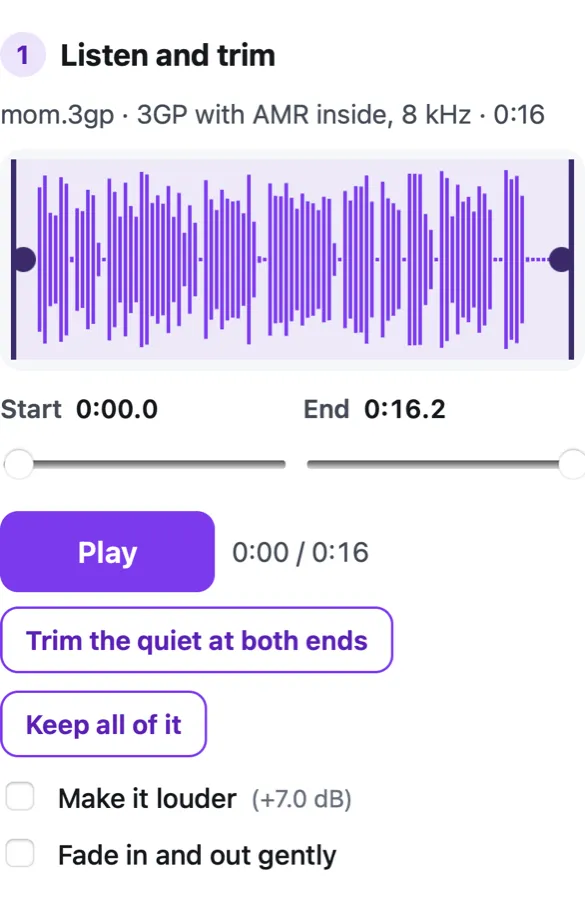
A 3GP test file (a made-up message) with AMR sound inside, opened at Android phone size: the line under the heading says what was found inside the file.
What could delete your Android voicemails?
- Turning off visual voicemail or transcription in Google’s Phone app (above).
- Clearing the voicemail app’s data. T-Mobile’s page warns: “Don’t clear the app cache or data, this will delete all of your voicemail messages”.
- Archiving and then losing the phone, since an archived message may be gone from the mailbox. Copy the file off the phone.
- The carrier’s time limits, if the message is still only in the mailbox: see AT&T, Verizon and T-Mobile.
What if your phone only has dial-in voicemail?
There’s no Save button for basic voicemail. Two carriers mention other routes: Verizon’s FAQ points to a paid outside service that makes permanent copies (the message must still be in the mailbox), and T-Mobile’s DIGITS app can download voicemails for customers who use it; both are on our Verizon and T-Mobile pages. Otherwise, play the message on speaker and record it with a second phone or a computer. It’s less perfect than a file, but the voice comes through. Our guide recording a voicemail you can’t export shows how to get a clean recording, and the tool then trims off the beeps and the mailbox’s spoken menu.
Questions people ask
How do I save a voicemail on a Pixel?
Google's Phone app: open it, tap Voicemail at the bottom, expand the voicemail, then tap Send to and choose an app (Files, Drive, email). If you can't find Voicemail, Google says your carrier may not offer visual voicemail and you'll need to call your voicemail instead.
How do I save a voicemail on a Samsung Galaxy?
Samsung's own pages say the options vary by carrier. On AT&T, touch and hold the message in Visual Voicemail and tap Archive (it moves to My Files › Internal Storage › VisualVoicemail). On Verizon, tap the message and tap Archive. Archiving can clear it from the mailbox, so keep the file.
Where are archived voicemails on Android?
AT&T's Samsung page says My Files › Internal Storage › VisualVoicemail. Verizon's says archived messages are saved to the device's internal storage. T-Mobile's app copies saved messages to the memory card. Open the My Files (or Files) app to find them.
Will turning off visual voicemail delete my messages?
In Google's Phone app, yes: Google says turning off visual voicemail deletes the recordings from the app (your carrier might keep a copy), and turning off transcription deletes recordings and transcripts. Save the files first.
Is VoicemailKeepsake free?
Yes, while we launch: opening an Android voicemail file (including AMR and 3GP), trimming it and saving MP3 and WAV copies cost nothing and need no sign-up. Later, saving the files will be part of Pro, $12 once.
Related
- Save a voicemail on iPhoneSave a voicemail from the iPhone Phone app as an audio file with the Share button, in the Unified and Classic layouts, then keep it as MP3 and WAV.
- AMR to MP3Convert an AMR or 3GP voicemail file to MP3 and WAV on your phone or computer. Decoded on your device, nothing uploaded. AMR-NB and AMR-WB.
- Record a voicemail you can't exportNo way to save a voicemail on your phone or carrier? Record it with iPhone call recording or on speaker into a second phone, then trim and keep it.
- When someone has diedKeep a loved one's voicemail before it's lost: what to do before the phone line is canceled, how to save it as a file, and how to keep it for good.
- All guidesEvery VoicemailKeepsake guide, by task.